Not Receiving SMS Messages?
Due to regulatory requirements, China's three major mobile carriers have continued to tighten SMS compliance policies since 2025. As a result, SMS messages may fail to send, be delayed, or not be delivered to certain recipients.
Common causes include:
- The SMS signature has not completed real-name verification.
- The SMS content contains links or phone numbers, which are highly likely to be blocked.
To send SMS messages to phone numbers outside Mainland China, you must first integrate and configure the Twilio International SMS Service.
Complete Real-Name Verification for SMS Signatures
Organization administrators can go to Org Admin > Organization > Org Info > Verification Info to add and manage SMS signatures.
Custom SMS signatures can only be used after they have been approved. If a custom signature has not completed real-name verification, you can use the system-provided signature 【明道云】 instead.
View or select an SMS signature:
-
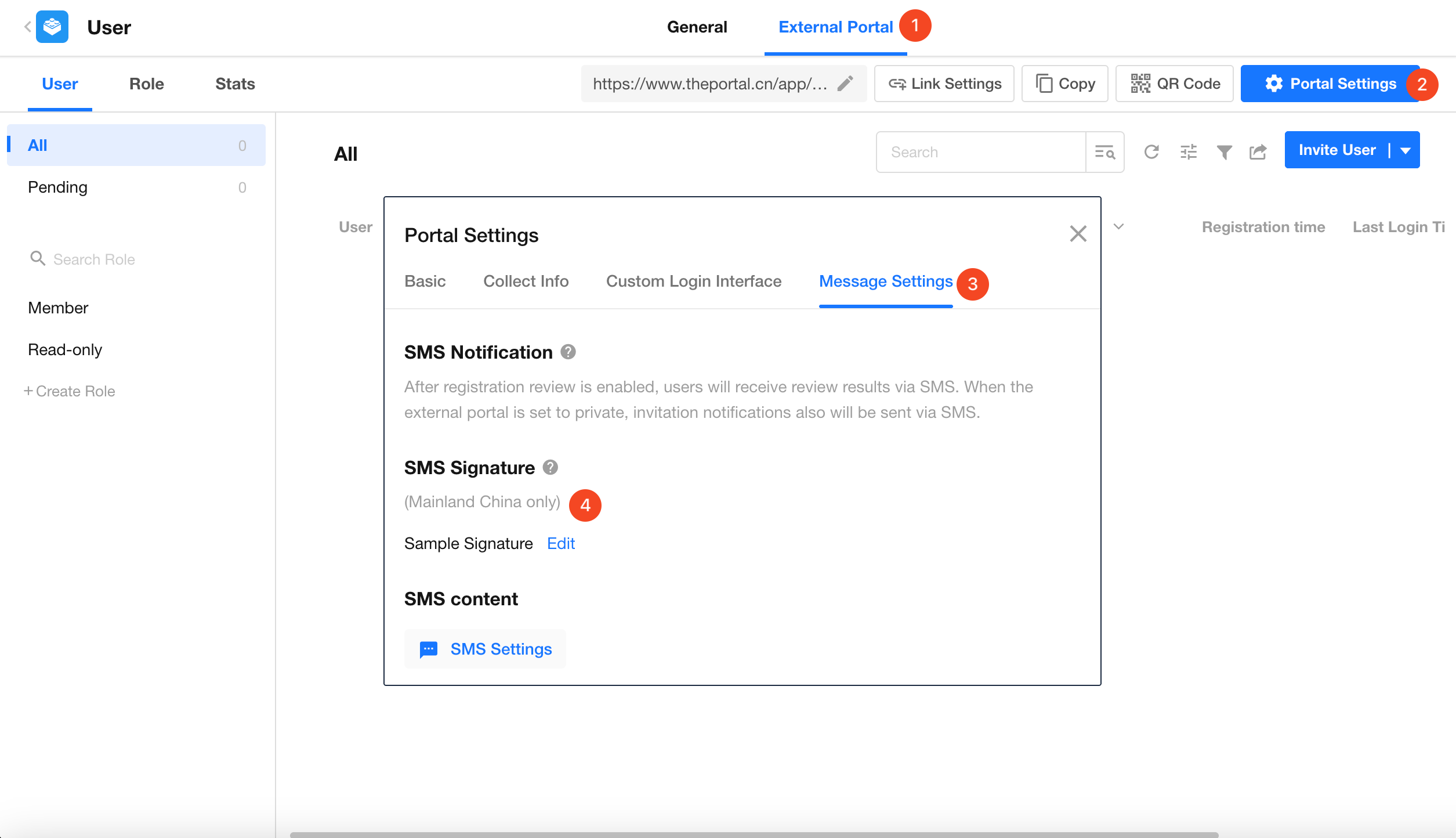
External Portal: Go to External Portal > Portal Settings > Message Settings to view and select a signature.
-
Send SMS workflow node: View the configured signature in the node settings.
-
Public Form: Go to Publish Settings and enable SMS Verification for Mobile Numbers.
Still Not Receiving SMS Messages After Signature Verification?
Register an SMS Template
If compliant SMS messages are still not delivered, you can register the SMS template to reduce the risk of carrier filtering.
Register an SMS Template (Real-name verification of the SMS signature must be completed first.)
Important:
- SMS messages containing links or phone numbers may still be blocked even after template registration.
- For messages without links or phone numbers, wait two business days after registration, then test delivery gradually in small batches.
Common Reasons SMS Messages Are Not Delivered
SMS Content Contains Links or Phone Numbers
The following content is likely to be blocked and should be removed whenever possible:
- Links and IP addresses
- Mobile numbers and landline numbers (including service numbers such as 400, 800, 9X, and 12X)
For more information, see:
Carrier Delivery Restrictions During Nighttime Hours
China Unicom and China Telecom may apply SMS delivery restrictions during nighttime hours (approximately 23:00–07:00).
If compliant messages are not received during this period, carrier-side delivery restrictions may be the cause. In such cases, try sending the message again later.
Incorrect SMS Category
Marketing SMS messages may be blocked if they are submitted as Industry Notice. Different SMS categories are subject to different compliance requirements.
- Notification SMS messages must not contain promotional or marketing content and must not include phrases such as "Reply R to unsubscribe".
- Holiday greetings, birthday messages, promotional campaigns, and similar content should be submitted as Marketing SMS.
Formatting Issues
- The total SMS length, including the signature, must not exceed 500 characters. Chinese characters, letters, numbers, punctuation marks, and spaces are all counted as one character.
- The characters 【】 are not supported. Use quotation marks instead.
- Special symbols such as ¥, ★, and combined symbols (for example, ^_^, ☞, ✓, ※) are not supported and may cause garbled text.
Content Is Too Generic
SMS messages with little or no meaningful content, such as "test", "123", or "notification notification notification", may also be blocked.
When testing, use realistic content instead, such as:
Your verification code is: 3587
Other Reasons
Certain keywords or message contexts may trigger manual carrier review, which can result in delayed delivery.
SMS Delivery and Billing Rules by Region
SMS delivery behavior depends on the destination region and the type of SMS being sent.
| Destination Region | SMS Type | Twilio Configured | Service Used | Billing Responsibility | Billing Rule |
|---|---|---|---|---|---|
| Outside Mainland China | Verification SMS | Yes | Organization's Twilio account | Organization's Twilio account | Charged based on actual Twilio costs |
| Outside Mainland China | Verification SMS | No | Platform SMS service | Organization credits | 2.3 credits per message |
| Outside Mainland China | Custom SMS | Required | Organization's Twilio account | Organization's Twilio account | Charged based on actual Twilio costs |
| Mainland China | Verification SMS and workflow SMS | N/A | Platform SMS service | Organization credits | Charged according to the platform's domestic SMS pricing rules |
Rules and Notes
- When sending verification SMS messages to international phone numbers, the system prioritizes the organization's configured Twilio account. If no Twilio account is configured, the platform SMS service is used.
- When using the platform SMS service, the system first checks whether the organization has sufficient credits. SMS messages cannot be sent if the credit balance is insufficient.
- When using the organization's own Twilio account, all SMS charges are billed directly to that Twilio account.
Was this document helpful?